
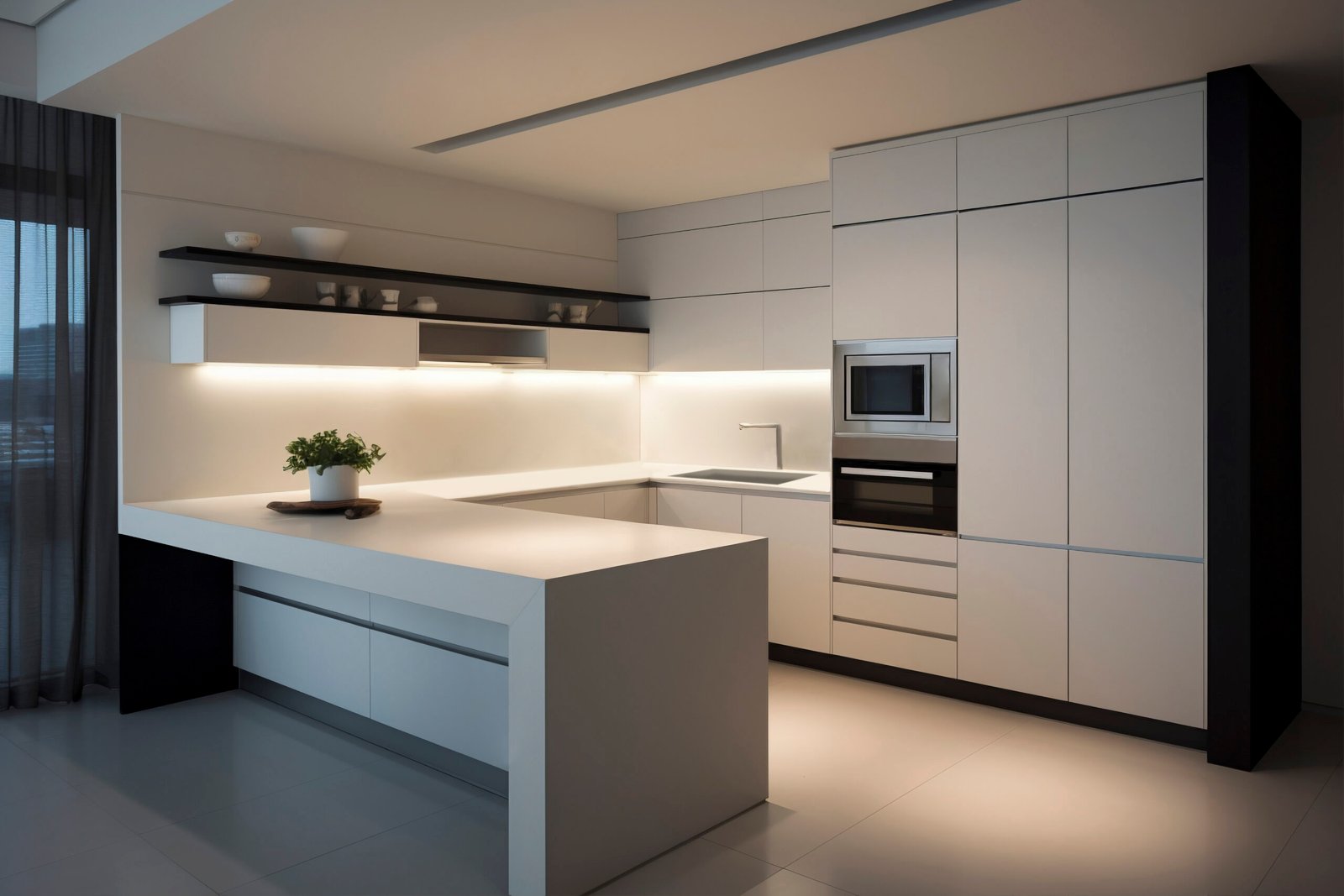
If you’ve started asking around for modular kitchen quotes in Coimbatore, you’ve probably noticed something frustrating: no two quotations look alike. One vendor says 1.8 lakh, another says 4.5 lakh, and you’re left wondering if they even looked at the same kitchen. The truth is, modular kitchen pricing isn’t random; it just depends on a handful of factors most people are never explained clearly.
By the end of this guide, you’ll know roughly what to budget, what pushes the price up, which layout suits your space, and what to ask before signing anything.
Table of Contents
The Quick Answer: What Does a Modular Kitchen Cost in Coimbatore?
For a standard 2BHK apartment, most homeowners in Coimbatore end up spending somewhere between ₹2 lakh and ₹3 lakh for complete modular kitchen cabinets, countertop, basic hardware, and installation included. That’s a good starting estimate to keep in your head while you plan.
Of course, that’s not a ceiling. A compact, no-frills straight kitchen can come in lower, while a large U-shaped or island kitchen with premium finishes can easily cross ₹5 lakh or more. Think of ₹2–3 lakh as your realistic starting point, not the final word.
If you prefer to think in terms of per-square-foot pricing, Coimbatore rates typically fall in the ₹1,200 to ₹3,000 per sq. ft. range, depending on the carcass material and shutter finish you choose. Compared to metros like Chennai or Bangalore, Coimbatore tends to be noticeably more wallet-friendly, one of the perks of building in a tier-2 city that’s also become a fairly established hub for furniture and interior manufacturing in its own right.
Modular Kitchen Price Per Square Foot in Coimbatore
Breaking costs down per square foot is one of the simplest ways to compare quotes across vendors, as long as you know what’s included.
| Kitchen Grade | Price per sq. ft. | What You Typically Get |
| Basic | ₹1,200 – ₹1,800 | MDF/particle board carcass, laminate shutters, basic hinges |
| Mid-range | ₹1,800 – ₹2,400 | Marine ply or better carcass, laminate/PVC finish, branded hinges |
| Premium | ₹2,400 – ₹3,000+ | Marine ply carcass, acrylic/PU/high-gloss finish, soft-close hardware |
So, for example, a 100 sq. ft. kitchen priced at ₹2,000 per sq. ft. would work out to roughly ₹2 lakh, but that figure usually covers cabinetry alone. Countertops, chimney, hob, and accessories are often billed separately, which is exactly why final invoices tend to surprise people who only budgeted based on the per-sq.-ft. number.
Modular Kitchen Cost by Size (2BHK, 3BHK, and Beyond)
Square footage is useful, but most homeowners find it easier to think in terms of home size. Here’s a rough sense of what to expect:
- Compact/1BHK kitchen: ₹1.2 lakh to ₹1.8 lakh
- Standard 2BHK kitchen: ₹2 lakh to ₹3.5 lakh
- Larger 3BHK kitchen: ₹3.5 lakh to ₹5.5 lakh
- Premium villas/independent houses with island or U-shaped layouts: ₹5.5 lakh and above
Treat these as starting ranges, not fixed prices. The material and hardware choices discussed below will move your final number up or down within (and sometimes beyond) these bands.
Modular Kitchen Cost by Layout
The shape of your kitchen has a bigger impact on cost than most people expect, mainly because it determines how much cabinetry and countertop you actually need.
Straight (single-wall) kitchen: Everything sits along one wall, which keeps material use to a minimum. This is the most budget-friendly layout, generally landing around ₹1.2 lakh to ₹2 lakh. It suits compact apartments and studio-style homes well.
L-shaped kitchen: The most popular choice among Coimbatore homeowners, and for good reason, it uses a corner efficiently, gives you more storage and counter space than a straight layout, and still stays reasonably economical. Expect somewhere around ₹2.2 lakh to ₹3.2 lakh.
Parallel kitchen: Two facing counters with a walking aisle between them. It offers more storage than an L-shape but needs more material on both sides, so costs typically sit between ₹2.5 lakh and ₹3.8 lakh. Works well for households that cook frequently and need dual workstations.
U-shaped kitchen: Ideal for larger spaces, wrapping cabinetry around three walls. Storage and workspace go up significantly, and so does the price, usually starting around ₹3 lakh and climbing depending on finish.
Island kitchen: The most premium and space-hungry layout, adding a standalone counter for prep, dining, or entertaining. An island typically adds another ₹1 lakh to ₹2 lakh on top of the base kitchen cost, but it also transforms how the space looks and functions.
In most homes, the available floor plan naturally narrows down your layout options. Your designer will usually be able to tell you within minutes which of these actually fits your kitchen.
What Actually Decides Your Final Bill
Two kitchens of identical size can differ by a lakh or more. Here’s why.
1. Carcass material. This is the “box” behind your shutters, the part you don’t see but rely on the most. MDF or particle board carcasses are the budget option and work reasonably well in low-moisture zones. Marine plywood costs more but handles Coimbatore’s humidity and daily wear far better over the years, especially near the sink and hob. If longevity matters to you, this is not the place to cut corners.
2. Shutter finish. Laminate is the affordable, practical choice and still looks sharp if you pick the right shade. Acrylic and PU (high-gloss) finishes look premium but cost noticeably more and show fingerprints more easily. PVC shutters sit somewhere in between budget-friendly and moisture-resistant, though not always as durable long-term as plywood-based options.
3. Countertop material. Granite is the popular, budget-conscious pick in Coimbatore and holds up well. Quartz and solid-surface counters look more refined and need less maintenance, but cost more per square foot.
4. Hardware and accessories. This is where quotes quietly balloon. Basic essentials like cutlery trays, bottle pull-outs, and standard drawers are inexpensive. Add-ons like magic corners, tandem box drawers, tall pull-out units, and pantry units cost significantly more and soft-close mechanisms carry a premium too. Branded hardware from names like Hettich or Hafele costs more upfront but tends to outlast unbranded alternatives by years. A tip that saves real money: don’t add every accessory the showroom shows you. Start with what you’ll actually use daily, and add extras later if needed.
5. Design complexity. Tall units, pantry cabinets, corner carousels, and custom-shaped countertops all add labour and material cost, even without changing the overall floor area.
6. Labour and installation. Some vendors bundle this into their quote along with designer fees; others add it separately. Always ask for an all-inclusive number so you’re not caught off guard at the final invoice.
Accessories and Appliances: The Hidden Cost Centre
Accessories are where a kitchen goes from “functional” to “genuinely enjoyable to cook in” but they’re also the easiest place for a quote to quietly grow.
Basic accessories, cutlery trays, simple bottle pull-outs, and standard drawer channels add up to a modest sum. Once you move into tandem box drawers, magic corner units, and lift-up cabinets, the cost per unit rises sharply, sometimes running into a few thousand rupees per piece for branded hardware. Multiply that across a full kitchen and it’s easy to see how a base quote of ₹2 lakh can climb to ₹3.5 lakh purely through accessory choices.
Appliances, such as a chimney, hob, built-in oven, and microwave, are almost always billed on top of the kitchen cost itself, not included in it. Plan for these separately from day one so your total renovation budget stays realistic.
A Word on Materials Suited to Coimbatore’s Climate
Coimbatore isn’t as humid as coastal cities, but kitchens everywhere deal with daily steam, spills, and heat. A few notes worth keeping in mind:
- Marine plywood remains the safest long-term choice for cabinets near the sink and stove, thanks to its water resistance.
- PVC kitchens are a genuinely good budget option here, moisture-resistant and low-maintenance, though they may not match plywood’s structural durability over a decade-plus timeframe.
- MDF/HDF works fine for upper cabinets and drier zones but isn’t the best pick directly under the sink.
How to Get a Low-Cost Modular Kitchen Without It Looking Cheap
You don’t have to spend big to get a kitchen that looks and works well. A few practical moves:
- Stick to a straight or L-shaped layout instead of U-shaped or island designs.
- Use laminate finishes on shutters instead of acrylic or high-gloss options.
- Limit tall units and pantry cabinets to what you’ll genuinely use.
- Don’t skip on hinges, even in a tight budget, cheap, unbranded hinges tend to fail within months, and shutters start sagging as a result.
- Plan your accessories in phases. Get the essentials installed now, and add baskets or organisers later as your budget allows.
- Get an itemised quote so you know exactly what’s driving the cost, rather than negotiating on a single lump-sum number.
Common Mistakes Homeowners Make While Budgeting
A few patterns show up again and again in Coimbatore kitchen projects:
- Comparing quotes without comparing specifications. A ₹1.8 lakh quote and a ₹2.8 lakh quote for the “same size kitchen” often aren’t comparable at all; one might be MDF with laminate, the other marine ply with acrylic.
- Forgetting appliances. Chimneys, hobs, and built-in ovens are almost always billed separately from the modular kitchen itself. Factor them into your total budget from day one.
- Ignoring the humidity and heat factor. Cheap board materials can warp or swell faster than expected if this isn’t accounted for near wet zones.
- Over-designing early. It’s tempting to add every accessory in the showroom catalogue. Start with a functional core and expand later, it’s kinder to both your kitchen workflow and your wallet.
- Focusing only on looks. A beautiful kitchen that’s inconvenient to cook in every day isn’t a good trade. Workflow and daily usability should weigh at least as heavily as finish and colour.
Final Thoughts
A modular kitchen is one of those investments you’ll interact with every single day, so it’s worth spending a bit of time understanding where your money is actually going. Use ₹2–3 lakh as your working estimate for a standard home, but let your layout, material, and hardware choices, not just the sticker price, guide your final decision. Get at least two or three detailed, itemised quotes before committing, and don’t hesitate to ask vendors exactly what’s included and what isn’t.
Frequently Asked Questions
1. What is the minimum budget for a modular kitchen in Coimbatore? A basic, compact modular kitchen with a straight layout and laminate finish can start around ₹1.2 lakh to ₹1.5 lakh. For most standard homes, though, a realistic starting estimate is closer to ₹2 lakh to ₹3 lakh.
2. Is plywood or MDF better for modular kitchens in Coimbatore? Marine plywood generally holds up better against moisture and daily wear, making it a stronger long-term choice, though it costs more. MDF or HDF is more budget-friendly and works fine for lower-moisture zones like upper cabinets, but it’s less ideal for areas near the sink or hob.
3. Does the modular kitchen price include chimney, hob, and other appliances? Usually not. Most vendors quote the kitchen units, countertop, and hardware separately from appliances like chimneys, hobs, and built-in ovens. Always confirm this upfront so there are no surprises in the final bill.
4. Which kitchen layout is the most affordable? A straight (single-wall) layout is the most economical since it uses the least amount of material and labour. L-shaped kitchens come next and offer a good balance between cost and storage, which is why they’re the most popular choice among Coimbatore homeowners.
5. How long does it take to install a modular kitchen in Coimbatore? Once the design is finalised, fabrication and installation typically take anywhere from 10 to 20 days, depending on the size and complexity of the kitchen and how busy the vendor’s production schedule is.
